
Our activism was born in these forgotten papers—and lies—generated decades ago, retooled and weaponized for our time.
By Charles Francis
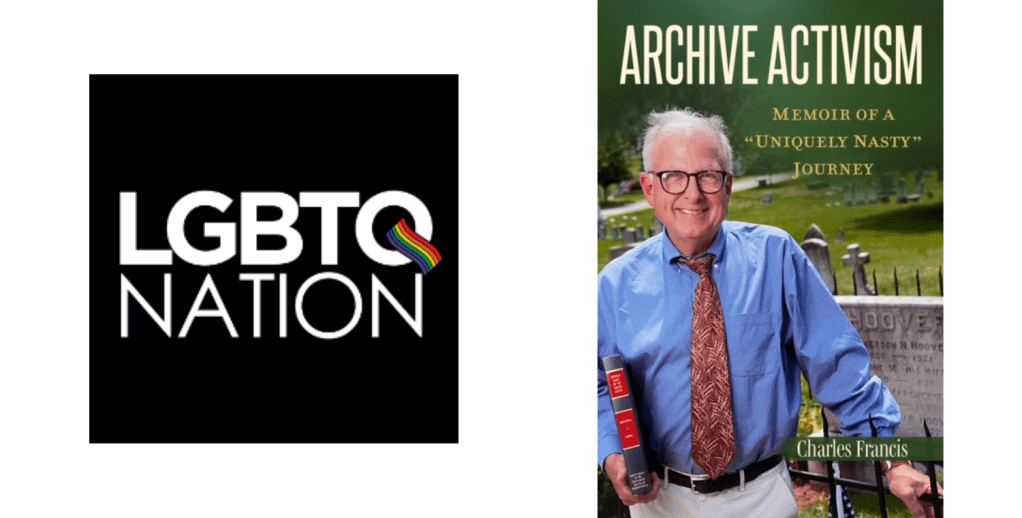
The following is an excerpt from the book, “Archive Activism: Memoir of a ‘uniquely nasty’ Journey” by Charles Francis and featured on LGBTQ Nation.
That’s me grinning at FBI director J. Edgar Hoover’s grave on the cover photo. I am relishing this moment. Like the millions of tourists who annually visit Washington for selfies and pics in front of their favorite attractions, I chose a grave for a feel-good image of my own. I, a citizen “sex deviate”—the pejorative and crime invented by Director Hoover decades ago—returned for a reckoning of my own. It took a lifetime for me to be able to stand here with a smile, no trace of anger, on my face.
I could have chosen other places and moments to tell my story—from White House ceremonies and holiday parties to Supreme Court hearings and events at the Library of Congress and the Smithsonian Institution exhibiting our work. Or maybe standing before a bower of plastic flowers with my husband at our marriage at the DC Superior Court. But this place is it—J. Edgar’s neatly fenced grave, a packaged plot for the tourists and dog walkers at Congressional Cemetery in Washington, DC. Here I can mark the distance LGBTQ Americans have traveled since his creation of the FBI Sex Deviates program in 1951, the year of my birth in Dallas.
I hold my bound copy of the Mattachine Society of Washington, DC’s amicus brief submitted to the Supreme Court in the case of Obergefell v. Hodges, the same-sex marriage victory that opened the door for a million LGBTQ Americans to marry those whom they love. That victory is now protected by federal law. This “friend of the court” brief presents our case for same-sex marriage.
Dubbed the “animus amicus” by the Washington Post, it steadies and delights me because it tells stories of endurance and courage we uncovered because they were erased or forgotten. “Animus, therefore, was a culture,” our brief declares. “And with that culture came a language. For decades, government officials referred to homosexuality in official, often highly confidential or privileged communications, as ‘unnatural,’ ‘abnormal,’ ‘immoral,’ ‘deviant,’ ‘pervert(ed).’ An ‘abomination.’ ‘Uniquely nasty.’”
From where I stand, going back in time to J. Edgar’s Sex Deviates program, one can measure the distance between our era and his. I was once so enmeshed and implicated in the long history of hiding that the liberation side of life’s equation would only come decades later, like a late blooming. For me it started atop a rickety pull-down ladder into a dusty attic—and with a new way to converse with history we call Archive Activism.
Continue reading on LGBTQ Nation.
 mattachinesocietywashingtondc.org