
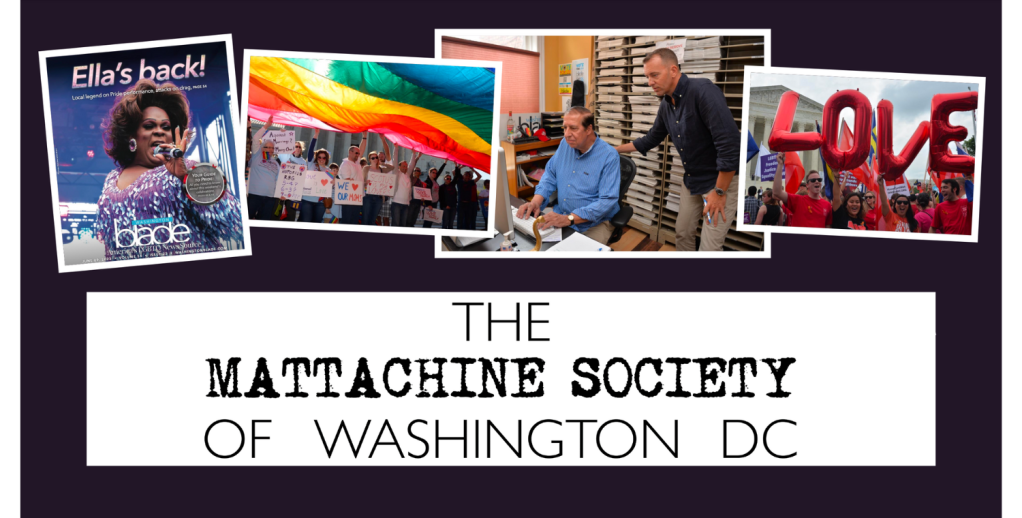
The Mattachine Society of Washington, DC to premiere documentary film Lou’s Legacy: a Reporter’s Life at the Washington Blade.
“Is the Mattachine Society still around?”, people ask incredulously when I tell them who we are. Was it like a club for old, white guys who wore skinny neckties before gay liberation?, they hack. I go along with the joke because laughter is the best place to begin in dark times. The original Mattachine Society founded by Harry Hay in 1950 in Los Angeles was named after the Medieval court jesters who would wear a mask in order to speak truth to the King. The idea of wearing a mask for self-protection caught on before the lives of LGBTQ Americans were decriminalized. In Washington D.C. gay civil rights pioneer Dr. Franklin E. Kameny found the name useful in 1961 because it was widely recognized as the nation’s first gay civil rights advocacy group. The crucial difference for Frank Kameny was that mask. He detested the entire federal system of investigation and legal assault that made the mask necessary for so many people and fought it to his death in 2011. Kameny won. When the federal government formally apologized to him, he famously replied: “Apology accepted!”.
Why then carry on such a legacy?
If LGBTQ Americans were safe and secure in an imaginary post-gay, queer Nirvana, we might let go of the fighting legacy bequeathed us by pioneers like Kameny. But we cannot. We are living at the far-right barricades now, erased from all federal websites, threatened at the U.S. Supreme Court; while transgender soldiers are labeled in derogatory language as people “not consistent with the humility and selflessness” required for military service. We remember this style of denigration applied to all of us in past decades.
We know where we come from. James Baldwin called this knowledge “that great force of history we carry within us”. When Baldwin wrote these words in 1965 for Ebony magazine, he was writing about confronting and understanding that deep history in the fight for racial justice. Yet as a black man mocked and disparaged for being queer (the Kennedys called him “Martin Luther Queen”) he would approve, we believe, of his idea’s application to LGBTQ Americans. Today, as never before, all of us must pay attention to every bit of our history and carry its force. We have traveled too far to accept a rewrite or erasure.
Our history is everything.
This is why we re-purposed in 2011 the Mattachine Society of Washington, DC into an LGBTQ history society with the motto “Archive Activism”. We “archive activists” conduct original archival research and use our discoveries in the fight for full civil equality. We also help others preserve, curate and donate their own materials to libraries and archives so that students, researchers and historians in future generations may use original, primary source materials that record every minute of our community’s struggle for equality. We did this for Frank Kameny, founder of the original Mattachine Society of Washington; and we did this for Dr. Lilli Vincenz, the first lesbian member of the Mattachine Society of Washington who picketed the White House with Frank in 1965. Because of our efforts, both Kameny’s and Vincenz’ papers are now held at the Library of Congress. We are not historians. We are activist citizens with library cards—a tough combination to beat with uncensored, well-funded public libraries. Public libraries are where archive activism lives. (For more information on how we rescue history, see “Archive Activism: Memoir of a ‘Uniquely Nasty’ Journey” (University of North Texas Press, 2023).
This year the Mattachine Society produced a documentary film, a result of our archive activism, entitled Lou’s Legacy: a Reporter’s Life at the Washington Blade. The film to be broadcast this PRIDE season, directed by Emmy-nominated D.C. filmmaker Patrick Sammon, tells the story of veteran Blade reporter Lou Chibbaro and the history of DC’s LGBTQ community through the lens of Lou’s four-decade reporting career at the Blade. The documentary explores our history in the District of Columbia through more than 350 boxes of Chibbaro’s reporter’s notes and audio cassette tapes dating to 1976 and meticulously preserved in the Chibbaro Archive he donated to the Gelman Library at George Washington University (GWU). Preparing these materials for donation, the Mattachine Society reviewed the boxes with Chibbaro—identified as “Laramie Courthouse Interview”, “Murders/Assaults”, “FBI Surveillance”, Mayor Marion Barry and hundreds more.
The world premiere screening of “Lou” will be held May 29th at the DC Public Library’s (DCPL) People’s Archive at the Martin Luther King, Jr. Library in Washington, DC. The Washington Blade in a partnership with DCPL digitized all of its editions beginning in 1969, as well as the Blade’s extensive photo archive, now held at the People’s Archive.
The Mattachine Society of Washington is proud to have helped Lou preserve and donate his papers, along with creating a finding aid, to the collection. Lou Chibbaro’s archive at GWU is a resource that cannot be rewritten or erased. It lives now for students, researchers and future historians at George Washington University.
The Mattachine Society lives on through these papers.
 mattachinesocietywashingtondc.org