

By: Charles Francis
As if the Ministry of Truth in George Orwell’s “1984” now existed, U.S. District Court Judge Cynthia Rufe ordered the government to restore a historical exhibit in Philadelphia that dared to mention slavery.
And later, in a similar government erasure attempt, there was a middle of the night removal of the Pride flag at the Stonewall National Monument in Greenwich Village that brought thousands of New Yorkers into the streets. What better time to start reading queer historical fiction. Facts can numb and fall short. Sometimes only a good historical novel can do justice to our history at this bizarre time of erasure.
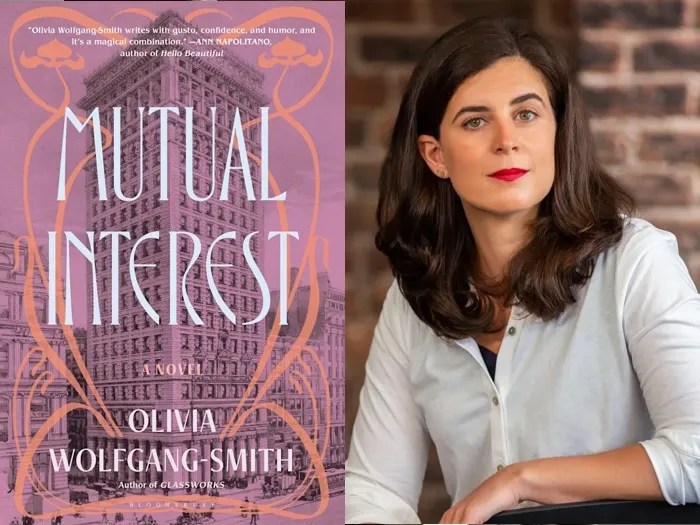
This is what Olivia Wolfgang-Smith’s novel, “Mutual Interest” delivers: the emotional texture of queer history spanning decades in pre-war New York City. It is the story of a happily twisted “throuple” consisting of two gay men, Squire and Clancey; and Vivian Lesperance, a brilliant lesbian who becomes the guys’ puppeteer; they build a business empire together.
Compelling throuple
Beginning in 1910, the story unspools before there was a lexicon of non-traditional relationships. No polyamory, no open-triads or other pan inventions. They are inventing it all with that perfect definition of love: “need in rhyme.” They call themselves a syndicate.
On one level the novel explores what made their syndicate rhyme through the 1910s, ’20s and ’30s in a city as raucous as New York. Squire, coming from New York high society, had the “know who,” but his problem is basic autism. His parents had attempted to commit him to an asylum, but he was declared not sufficiently insane. He is hilariously weird.
Oscar, raised on a “ghost of a farm” in Ohio, escaped to Cincinnati to work for a soap making company. Oscar provides the “know how” to create this new invention of scented soaps. But his problem is he’s a corporate nobody, living a gay double life in a somebody town.
Vivian is a masterful manipulator who can serially seduce, then drop the bohemian, arty ladies and girls. Her problem is the “how to,” how to create something, anything, that will allow her to climb the New York City ladder. Her vulnerability, the stark terror of failure and a one-way ticket home to her very creepy family in Utica.
These dynamics lock them in and propel the prewar throuple to meet their urban queer fate. Together they become wildly rich, miserably in love and doomed on the edge of the emerging queer metropolis of the modern era.
Life strategies
The “syndicate” keeps morphing living strategies and cover stories to keep up with the times, and beyond the emerging labor unions. Vivian and Oscar marry as a cover both for their business enterprise and Oscar’s relationship with Squire. This worked until prosecutions of queers (and the businesses at which they gathered) were on the rise, and legislation lagged decreasingly far behind the evolving social concept of female inversion.
All of Vivian’s careful coverage –her public and respectable marriage; her anonymity in approaching and hosting women; her meticulous limitation of her conquests to a few encounters per girl– served her well enough in daily life, among a basically stupid populace, she thought.
Vivian is a character trapped between the walls of her business life, her private sexual life and a gender role imposed upon women of her time, despite the activism of suffragists and women’s equality movements. The magnetic character of Vivian, who privately thinks such thoughts about the “stupid populace,” brings to mind Garbo or a young Glenda Jackson.
Once Vivian “had identified her quarry, all the rest was triangulation,” writes Wolfgang Smith. She gets what she wants. Through Vivian, “Mutual Interest” provides heightened insight into identity and gender, both in business and in bed, without academic-speak. The author asks, “Is there a more beautiful sight than a woman going fast enough under her own power to escape her demons?” Until the demons catch up.
Questions like this posed directly to the reader, break the “fourth wall” of the novel. Called an “authorial intrusion,” this was a common device in Victorian 19th-century novels, yet it’s odd and a little jarring to come across this device or style today.
Regarding Oscar and Vivian’s wedding, Wolfgang-Smith turns directly to the reader and asks, “Does this surprise you, given what you know of them, given what they by this point knew of each other? Consider, then, the solemn, holy, suffocating weight of institutions. Consider the confusions of youth… Tell us. Tell Vivian and Oscar!”
The effect of this archaic style is a lot of fun and powerful, but why Dear Reader? She uses this style to great effect emphasizing we are flying through a 19th-century world into another universe of accelerating change.
“Our subject is change-–inevitable, relentless. There is nothing to do but turn the page,” Wolfgang-Smith looks us in the eye. So, we turn the page and cannot stop following our throuple to their surprising end. Such authorial intrusions are like an AI photo restoration app, bringing a grandparent’s wedding from a scrapbook to life. “Mutual Interest” is a cultural translation from a queer pre-war New York to our time that will grab you by the frock coat. Loosen your corset. The story of this throuple is beyond erasure because it is so much fun.
Olivia Wolfgang-Smith’s “Mutual Interest,’ Bloomsbury Publishing,
$26 hardcover, $17 paperback, $15 ebook, $13.50 audiobook
https://www.bloomsbury.com/
https://wolfgangsmith.squarespace.com/
Originally posted on The Bay Area Reporter.

