
Pioneering author John D’Emilio continues to enlighten us in new book ‘Making Gay History’
“Dear Dr. Kameny,” wrote the earnest graduate history student almost 50 years ago. “As you know, the academic community only rarely deemed the lives of gay men and women to be worthy of serious scholarly study. To my knowledge, no American history faculty at a major university has yet sponsored a dissertation that deals with gays historically.”
That student was a young man from the Bronx who would change all that. His name is John D’Emilio.
“I must be able to uncover ‘manuscript’ sources, that is unpublished and unique historical materials,” he explained to D.C. gay civil rights pioneer Dr. Franklin E. Kameny who lived in a house stacked to the ceiling with “unique historical materials.” In reality, these were piles of correspondence with government officials and politicians, legal filings, mimeograph copies, gay newspapers, press releases, Mattachine Society brochures and picket signs. Frank Kameny, a self-described “pack rat,” invited D’Emilio into his private world of papers and memorabilia to begin uncovering an erased and forgotten pre-Stonewall history. This was one of many such research forays into “basements, garages and overcrowded living rooms” across America conducted by John D’Emilio. He was a young man on fire to complete a Ph.D. dissertation at the frontier of a distant galaxy — writing a scholarly gay and lesbian history backed by original research where there had been none, only a void.
Reading D’Emilio’s memoir “Making Gay History” (2026, Duke University Press) one has the sense of watching an emerging galaxy spinning around a galactic core of New York scholars and their mentors, young activists, and community historians throbbing with the New York City energy celebrated by Walt Whitman a century before in his epic poem “Mannahatta”. Spinning out of the ‘60s anti-Vietnam War activism; Marxist historical analysis, the Stonewall riots and gay liberation, we can see it coalescing around this one history student’s search for a dissertation topic and himself piecing together a new history that “no one had yet written about … a pioneering work in this newly emerging field.” D’Emilio pitches his idea for a dissertation that “spanned the length of U.S. history, moving from the religious teachings that shaped law and social attitudes … to how the federal government dealt with the increasing visibility of a homosexual world in the twentieth century.” With the blessings of Columbia’s Department of History, he completed his dissertation leading to the publication of his groundbreaking history: “Sexual Politics, Sexual Communities: The Making of a Homosexual Minority in the United States” (1983). When he received his first copy of the bound book in the mail, he “cradled the book in my arm holding it close to my chest….It was as if I had fathered a child.”
More so, D’Emilio fathered a new history. Historiography is the story of how history gets written, conducting original research, uncovering the data and creating the narrative(s) — often a snoozing read of academic process. But not this historiography. “Making Gay History” is a historiography with heart.
“Nothing was going to stop me from giving everything I had to this effort at making change in society and myself,” he declares while connecting with others who share his “boundless excitement for the collection of documents.” There were many others in this spiral with D’Emilio who are mentioned and play important roles. In the spiral were Jonathan Ned Katz (“Gay American History”, 1976); Allan Berube (“Coming Our Under Fire” 1990), Martin Duberman (“Hidden from History”, 1989); Daughters of Bilitis activists Del Martin and Barbara Gittings; Civil War historian Eric Foner and author/activist Larry Kramer. No libertarians among them. Well, maybe the divine Bette Midler who was well known for performing uptown at the Continental Baths who makes an appearance at a Washington Square rally.
He craved his parents’ approval. Among the most riveting scenes in the memoir are a series of family dinners in the Bronx with his old-school parents who go into near shock when he tells them he is gay. How to evade this any longer, especially now that his dissertation is going to be on homosexuality? It is a moving and hilarious sequence. After he says it out loud, “I am gay”: “No. No. No!” his father gasps. “This can’t be true. It can’t be.” D’Emilio thinks, “Oh my God, he’s going to die. I’ve killed my father.”
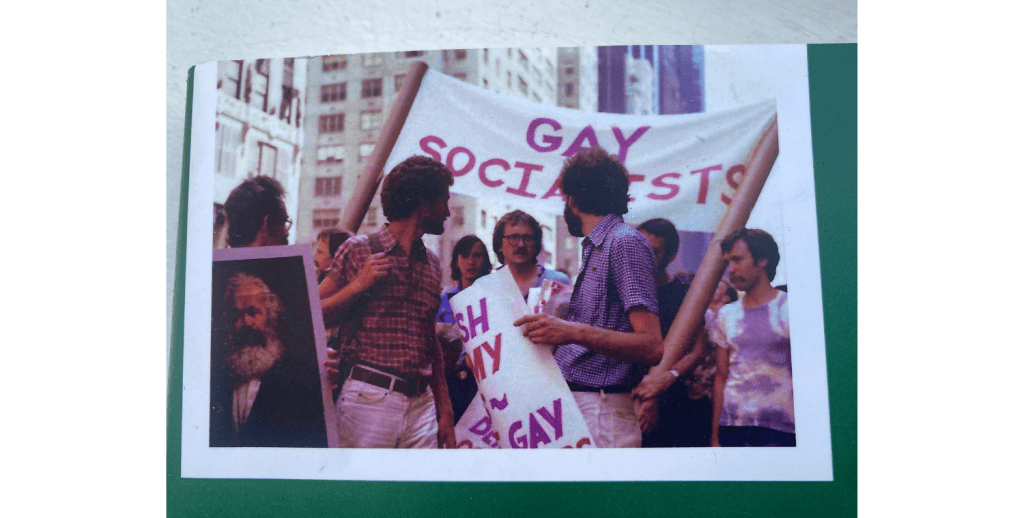
The D’Emilios — Vincent and Sophie — so resemble the wonderful Castorinis in “Moonstruck,” I am thinking “Oh my God, this is Cher coming out to her parents Cosmo and Rose.” The young graduate student survives the family dramatics even more certain that this was not just his success but “a gay liberation success.” From the family dinner table to the streets, he writes how he marched in the 1973 Pride parade beneath a banner held high: “Gay Socialists.” This man is a born scholar-activist.
D’Emilio does not seem able to pull back. There are passages that veer into autobiographical minutia, detail about the grind to earn a living from the University of North Carolina Greensboro to the University of Illinois Chicago. He writes, ”I would be living on less than half my usual salary for the year, but with the small amount of royalties that I got for my three books, plus some occasional speaking gigs and dipping into savings…”. Much of this is gray matter compared to the galaxy John D’Emilio helped energize that even now brightens our sky.
‘Making Gay History, Memoir of a Scholar-Activist’
By John D’Emilio
Dukeupress.edu/making-gay-history
Charles Francis is president of The Mattachine Society of Washington, D.C. and author of “Archive Activism: Memoir of a ‘Uniquely Nasty’ Journey” (University of North Texas, 2023)

